The biggest decision for a new wood floor often comes down to solid hardwood vs engineered wood flooring. While they look similar, their differences in cost, durability, and water resistance are crucial. At Floordi, we want to empower your choice. This expert guide breaks down everything you need to know from construction to cost to select the perfect flooring for your home.
Key takeaways
- Solid Hardwood: The traditional choice, made from a single piece of timber. Its greatest strengths are its incredible longevity (100+ years) and the ability to be sanded and refinished many times. It's best for main living areas but is vulnerable to moisture.
- Engineered Hardwood: A modern innovation featuring a real hardwood top layer over a stable, multi-layered core. Its key advantage is superior resistance to humidity and temperature changes, making it suitable for any level of the home, including basements and kitchens.
- The deciding factor: Your choice will likely come down to three things: location (is it a moisture-prone area?), budget (upfront vs. long-term cost), and longevity (do you need a floor for 30 years or 100+ years?).
1. Quick Solid Hardwood vs Engineered Comparison
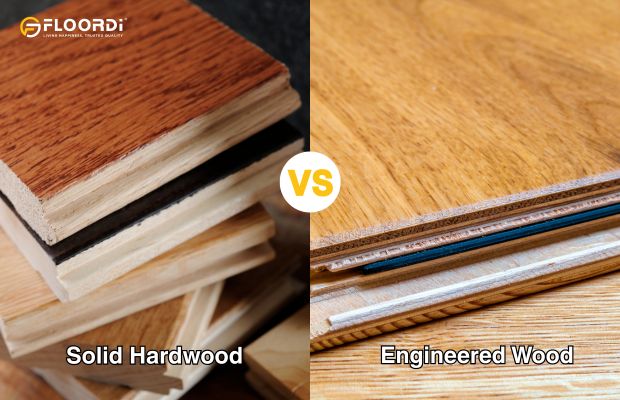
For a quick overview, here’s how these two popular wood flooring options stack up against each other.
|
Feature |
Solid Hardwood |
Engineered Hardwood |
|
Construction |
A single, solid plank of 100% hardwood, typically 3/4-inch thick. |
A top veneer of real hardwood bonded to a core of multi-layered plywood or HDF. |
|
Typical cost |
Higher material cost: $8 - $15 per sq. ft. |
More budget-friendly: $4 - $7 per sq. ft. for mid-range options. |
|
Lifespan |
Generational: 100+ years with proper care. |
Long-term: 20 - 40+ years, depending on the quality and wear layer. |
|
Refinishing |
High potential: Can be sanded 4-10 times. |
Limited to none: Can be sanded 0-5 times, based on wear layer thickness. |
|
Moisture resistance |
Low: Prone to warping and cupping in humid environments. |
High: Dimensionally stable and resists moisture-related damage. |
|
Installation |
Limited: Best for on or above-grade levels over a wood subfloor. |
Highly versatile: Suitable for all levels, including basements and over concrete. |
2. Construction: The core difference
To understand the pros and cons, you first need to understand how each plank is made. The difference between hardwood and engineered wood floors starts here.
What is Solid Hardwood Flooring?
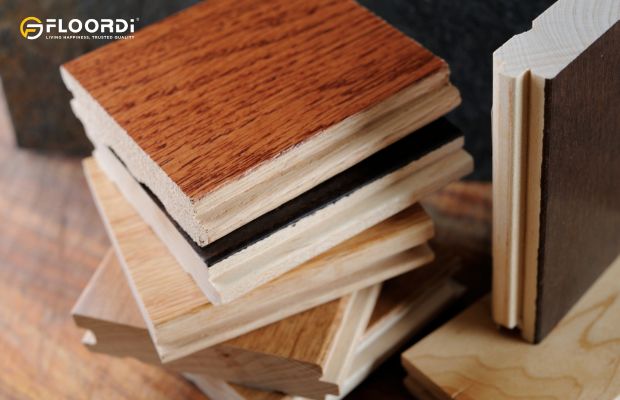
Solid hardwood is exactly what it sounds like: each plank is milled from a single, solid piece of timber. There are no layers, no composites, just 100% pure hardwood from top to bottom.
Composition: Typically 3/4-inch thick, its thickness is its strength, allowing for a long life of refinishing.
Integrity: This simple, pure construction gives it a renowned solid feel and structural integrity.
What is Engineered Hardwood Flooring?
Engineered hardwood is a marvel of modern flooring technology, designed to overcome solid wood's natural instability.
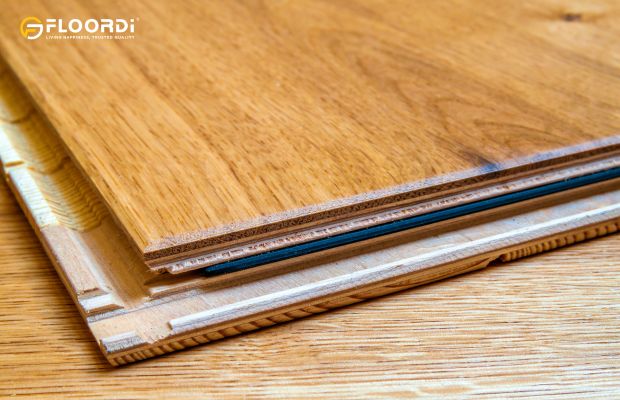
Composition: It's a multi-layered plank.
- Wear layer: The top is a veneer of real hardwood (like Oak, Maple, or Hickory). This is what you see and feel, and it's what makes it indistinguishable from solid wood once installed.
- Core: Beneath the veneer is a core of multiple layers of plywood or High-Density Fiberboard (HDF). These layers are arranged in a cross-grain pattern, which prevents the plank from expanding and contracting with humidity changes. This is the key to its dimensional stability.
3. Cost: Upfront investment vs. Long-term value
The cost of solid hardwood flooring vs engineered is a major consideration. While solid wood is often a larger upfront investment, the total cost can be more nuanced.
Material cost:
- Solid Hardwood: Typically ranges from $8 to $15 per square foot, according to sources like This Old House.
- Engineered Hardwood: Offers a wider price range. You can find quality mid-range options from $4 to $7 per square foot, though premium versions with thick wear layers can cost as much as solid wood.
Installation cost:
- Solid Hardwood: Installation is more labor-intensive (nail-down or staple-down) and requires a wooden subfloor, often costing $8 to $15 per square foot.
- Engineered Hardwood: Installation is more versatile and often cheaper, around $6 to $12 per square foot. The availability of floating "click-lock" systems makes it a popular choice for DIY projects, which can save you the entire cost of labor.
Floordi Expert Tip: If you have a concrete subfloor (common in basements and condos), engineered hardwood is a clear winner on cost. It can be installed directly over concrete, whereas solid wood would require the costly addition of a plywood subfloor.
4. Durability and lifespan: A generational floor vs. A long-term solution
When we talk about durability, we're looking at two things: resistance to daily wear and the ability to be restored over time.
Hardness and scratch resistance
The ability of a wood floor to resist dents is measured by the Janka Hardness Test. A higher Janka rating means the wood is harder. This applies to both solid wood and the top wear layer of engineered wood.
However, scratch resistance is primarily determined by the factory-applied finish. Most modern floors from quality brands like Floordi use an aluminum oxide finish, which provides excellent protection against surface scratches for both types of flooring.
Refinishing and lifespan: The critical "Wear layer"
This is where the two flooring types diverge most significantly.
Solid Hardwood: With its 3/4-inch thickness, a solid wood floor can be sanded and refinished 4 to 10 times. This means you can erase decades of wear and tear, making the floor look brand new again and again. With proper care, its lifespan can easily exceed 100 years.
Engineered Hardwood: Its ability to be refinished depends entirely on the thickness of its top hardwood wear layer.
- A thin wear layer (< 2mm) cannot be sanded.
- A quality wear layer (2mm - 3mm) can be sanded 1 to 2 times.
- A premium wear layer (4mm+) can be sanded 3 to 5 times, approaching the longevity of solid wood.
The lifespan of an engineered floor typically ranges from 20 to 40 years, but a high-quality product with a thick wear layer can last much longer.
The bottom line: If you are looking for a "forever" floor for a family home that can be passed down through generations, solid hardwood is unmatched. If you plan to be in your home for 10-20 years, a quality engineered floor offers outstanding durability and value.
5. Water and heat resistance: The stability advantage
Wood and water are natural enemies, but how each floor handles moisture is a key differentiator.
Solid Hardwood: As a solid piece of wood, it is highly susceptible to moisture and humidity. It will expand in humid conditions and shrink in dry ones, which can lead to permanent warping, cupping, or gapping. For this reason, solid hardwood is not recommended for basements, full bathrooms, or over radiant heating systems. For below-grade or wet rooms, browse basement flooring options and bathroom flooring options.
Engineered Hardwood: This is where engineered flooring truly shines. Its cross-layered core provides superior dimensional stability, preventing it from warping or cupping like solid wood. This makes it the ideal choice for environments with fluctuating humidity. It is perfectly suited for:
- Basements and other below-grade areas.
- Installation directly over concrete slabs.
- Homes with radiant heating systems.
- Kitchens, where spills and humidity are common. See flooring options for kitchens.
6. Appearance, sizes and sound
While both floors offer the authentic beauty of real wood, there are subtle differences in style and feel.
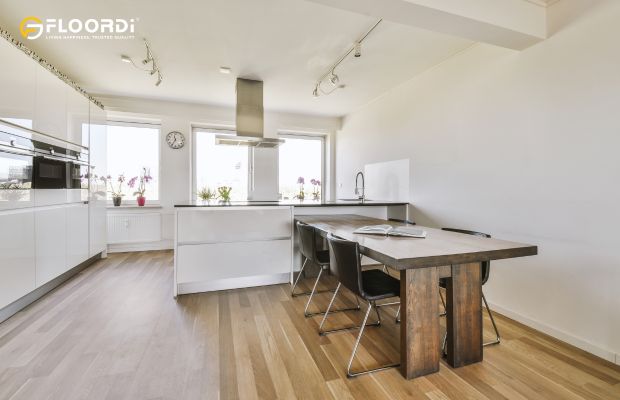
Appearance: Once installed, high-quality engineered wood is visually indistinguishable from solid wood. You get the same natural grain, knots, and character.
Sizes (Plank Width): Engineered hardwood offers more design flexibility. Its stability allows for much wider planks (7 inches or more), a popular look in contemporary design that is risky with solid wood.
Sound: Solid hardwood has a distinctly... well, solid feel and sound underfoot. Engineered flooring, if installed using a "floating" method, can sometimes produce a slightly more hollow sound. However, this is easily eliminated by choosing a glue-down or nail-down installation, which makes it feel and sound just like solid wood.
7. Environmental impact
From a resource perspective, engineered hardwood often has a greener footprint. Because only the top layer is premium hardwood, it utilizes less of a slow-growing tree per plank than solid hardwood. The core is often made from faster-growing, more sustainable wood species.
At Floordi, we are committed to sustainability. We ensure both our solid and engineered products are sourced from responsibly managed forests and meet strict low-VOC (Volatile Organic Compounds) standards for healthy indoor air quality.
8. Care & maintenance
The daily cleaning routine for both floors is identical:
- Sweep or vacuum regularly with a soft-bristle head.
- Clean up spills immediately to prevent moisture damage.
- Use a damp mop (never a soaking wet or steam mop) with a pH-neutral cleaner designed for wood floors.
The main difference is in long-term repair. A deep gouge in solid hardwood can always be sanded out during a future refinishing. On an engineered floor with a thinner wear layer, a deep scratch might be permanent, sometimes requiring the replacement of a single plank.
If easy upkeep is a priority but you want the wood aesthetic, compare engineered hardwood vs laminate for day-to-day practicality.
9. The final verdict: Which wood floor is right for you?
There is no single "best" choice in the solid hardwood vs engineered wood flooring debate. The best floor is the one that fits your specific needs.
Choose Solid Hardwood if:
- You are looking for a "forever" floor with a 100+ year lifespan.
- Authenticity and the ability to refinish multiple times are your top priorities.
- You are installing on or above ground level over a wooden subfloor.
Choose Engineered Hardwood if:
- You are installing in a basement, kitchen, or over a concrete slab.
- You live in a climate with high humidity or want to use radiant heating.
- You love the look of wide planks.
- You are a DIY enthusiast looking to save on installation costs.
The choice is yours, but you don't have to make it alone. The experts at Floordi are here to help you weigh the pros and cons and find the perfect wood floor to bring your vision to life.
Ready to find your perfect floor? Schedule a free consultation with a Floordi flooring expert today!