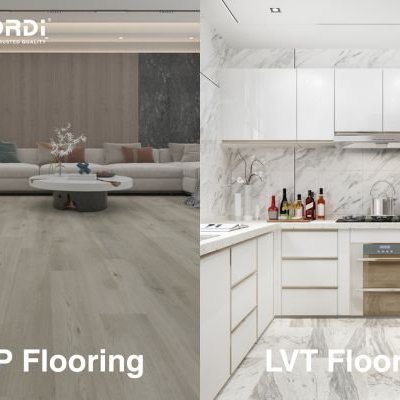
In today’s flooring market, waterproof luxury vinyl is one of the fastest-growing categories. Among the many options available, WPC (Wood Plastic Composite) and SPC (Stone Plastic Composite) stand out as two premium choices.
Both are designed to provide durability, resistance to water, and realistic wood or stone looks, but their performance varies depending on how they are made. Understanding the differences in structure, comfort, stability, and cost will help you choose the right product for your home or business.
Summary
Both WPC and SPC belong to the luxury vinyl plank (LVP) family. They share a layered construction with a wear layer, printed design layer, rigid core, and often an attached underlayment. The main distinction lies in the core:
- WPC Flooring: Features a foamed composite core, making it softer, warmer, and quieter underfoot. It is often preferred in residential settings where comfort is a priority.
- SPC Flooring: Features a denser, limestone-based core, making it extremely rigid, durable, and stable. It is ideal for high-traffic areas, commercial spaces.
Core Composition & Structure
Despite having similar layered structures (wear layer, design layer, core, underlayment), the core is the critical differentiator.
|
Feature |
WPC Flooring |
SPC Flooring |
|
Core Material |
Wood Plastic Composite: A blend of wood flour/wood pulp, thermoplastics (like PVC), and foaming agents. |
Stone Plastic Composite: A denser mix of limestone powder (calcium carbonate), polyvinyl chloride (PVC), and stabilizers. |
|
Core Density |
Lower density, more porous due to the foaming process. Softer and more compressible. Approx. 0.8 ± 0.05 g/cm³ |
Very high density, virtually non-porous. Extremely hard and rigid. Approx. 2.1 ± 0.05 g/cm³ |
|
Typical Thickness |
Generally thicker (5 mm to 12 mm), with a significant portion being the core itself. |
Often thinner but denser (4 mm to 8 mm). The rigidity comes from density, not thickness. |
|
Integrated Underlayment |
Almost always includes an attached foam pad (IXPE or EVA) for sound absorption and comfort. |
May or may not have an attached underlayment. Some premium lines include it for noise reduction. |

Performance Comparison
|
Characteristic |
WPC Flooring |
SPC Flooring |
Winner / Note |
|
Durability & Dent Resistance |
Good, but the softer core can be susceptible to heavy, concentrated pressure (e.g., sharp furniture legs, high heels). |
Excellent. The ultra-dense core is highly resistant to denting and indentation from heavy objects. |
SPC for extreme dent resistance. |
|
Water & Moisture Resistance |
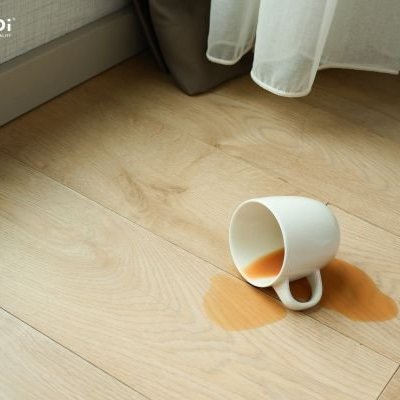
100% Waterproof. The plastic composite core is impervious to water. Perfect for bathrooms, kitchens, basements. |
100% Waterproof. Even more resistant due to its stone-based, inert core. Unaffected by humidity and moisture. |
Tie. Both are excellent. |
|
Dimensional Stability |
Very stable, with low expansion/contraction rates. Suitable for most rooms. |
Extremely stable. Has the lowest expansion/contraction rate of any vinyl flooring. Ideal for large areas, sunrooms, and problematic subfloors. |
SPC for maximum stability. |
|
Comfort & Underfoot Feel |
Softer, warmer, and more comfortable to stand on for long periods. The core acts as a cushion. |
Firmer and harder underfoot. Can be less comfortable, especially in kitchens. May feel "cold." |
WPC for comfort and warmth. |
|
Sound Absorption & Noise |
Quieter. The foamed core and attached underlayment absorb sound, reducing hollow noises and footfall sounds. |
Can be louder and produce a more hollow sound without a premium attached underlayment. |
WPC for acoustic performance. |
|
Subfloor Imperfection Handling |
The thicker, softer core can bridge minor subfloor imperfections and feel smooth underfoot. |
The rigid core will telegraph even minor subfloor imperfections. Requires a very flat, smooth subfloor. |
WPC for forgiving installations. |
Cost Considerations
- SPC Flooring: Typically has a lower price point than WPC. The raw materials (limestone) are cheaper than the polymers and foaming agents used in WPC.
- WPC Flooring: Commands a premium price due to its more complex manufacturing process, thicker profile, and integrated comfort features.
Note: Pricing for both can vary significantly based on the quality of the wear layer, design layer realism, and brand reputation.
Advantages and Disadvantages
|
Advantages |
Disadvantages |
|
|
WPC Flooring |
- Softer, more comfortable underfoot feel - Warmer to the touch - Excellent sound absorption (quieter) - Can mask minor subfloor imperfections - Still highly durable and waterproof |
- Generally more expensive - Less resistant to denting from extreme point loads - Not as dimensionally stable as SPC in extreme temperature swings |
|
SPC Flooring |
- Superior dent and impact resistance - Maximum dimensional stability - Often more affordable - Thinner profile good for transitions to other floors |
- Hard, sometimes uncomfortable underfoot - Can sound hollow without a quality underlayment - Requires a perfectly flat subfloor - Feels cooler to the touch |
Conclusion and Recommendation
There is no single "best" option—the right choice is determined by your specific needs.
- Choose WPC Flooring if: Your priority is comfort, noise reduction, and a softer feel. It is the ideal choice for most residential applications, especially in bedrooms, living rooms, and upstairs areas. It is better for homes with children or anyone who spends a lot of time standing on the floor.
- Choose SPC Flooring if: Your priority is maximum durability, stability, and value. It is the best choice for high-traffic areas, commercial settings, homes with heavy furniture or pets, and rooms with large temperature fluctuations (like sunrooms). It is also the preferred budget-friendly option.