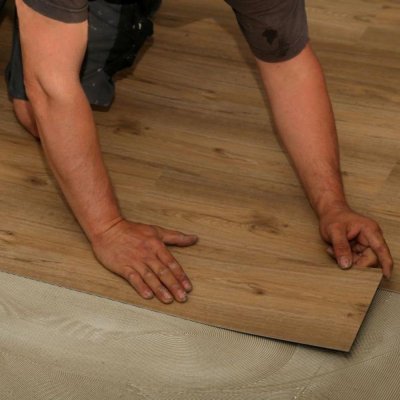

SPC flooring has grown rapidly because it is water resistant, dimensionally stable, and simple to install. That scale-up has also increased price pressure in supply chains. In lower-cost production, some manufacturers blend recycled PVC streams that may carry legacy additives back into new products. Independent market testing in 2024 found phased-out chemicals in new PVC flooring, which shows how yesterday’s additives can reappear through recycling today. [1]
Composition of SPC, and why it matters
To understand risk, start with the core chemistry.
- Rigid PVC matrix. SPC cores are based on rigid or minimally plasticized PVC, designed for stiffness. The problem begins when flexible, plasticized PVC waste such as old flooring or cable jacketing is ground and blended into rigid mixes. That practice can reintroduce phthalate plasticizers and, in some cases, legacy heavy-metal stabilizers. [15]
- Calcium carbonate filler. High CaCO₃ loadings add stiffness and lower cost, but do not control chemical safety. Overfilling, combined with inconsistent recycled feedstock, correlates with brittle click systems and color drift rather than safer chemistry.
- Stabilizer system. Modern rigid PVC commonly uses calcium zinc stabilizers, replacing historical lead or cadmium systems. European industry programs completed the lead stabilizer phase-out in 2015, but legacy-lead can still be carried over by recycling older PVC if segregation and screening fail. [3][15]
The recycled-input risk pathway
This section links material choices to contamination outcomes, then to practical risks indoors.
1) Sources of legacy additives
- Post-consumer PVC. Old vinyl floors, cable insulation, flexible hoses, and other PVC articles manufactured before lead and certain phthalates were restricted. These sources often contain lead-based stabilizers or DEHP. [1][4][15]
- Post-industrial scrap. Trimmings and regrinds from production lines that once ran legacy formulations. If scrap management is weak, cross-contamination occurs. [15]
2) How contaminants persist into new flooring
- Insufficient segregation and labeling. Recyclers and converters may commingle rigid and flexible PVC or mix old scrap with new resin to hit a price target. Legacy additives do not evaporate or disappear during remelting. [1][15]
- Screening gaps. Without routine XRF triage for heavy metals and targeted lab confirmation, contaminants pass into finished goods. Regulators and labs widely use XRF as a rapid screening tool, followed by digestion and ICP for confirmation. [11][12][13]
3) Health impacts in plain terms
Long service life and constant proximity. Flooring remains in place for decades. If legacy lead or DEHP has been carried over, exposure potential is extended for sensitive populations such as children. [1][5]
Lead has no safe level in children, even low blood lead concentrations correlate with measurable learning and attention deficits. [5][8][18]
Cadmium is toxic to kidneys and bone, and is classified as a human carcinogen. [6][14][19]
DEHP and related phthalates are under continuing regulatory scrutiny due to endocrine and developmental risks. [4]
Contaminants and typical origins
| Contaminant | Why it was used | Typical legacy source in recycling | Health concern snapshot |
|---|---|---|---|
| Lead (Pb) | PVC heat stabilizer in older articles | Post-consumer flooring, pipes, cable jackets | No safe blood lead level in children, neurodevelopment harms [5] |
| Cadmium (Cd) | Older stabilizer | Legacy rigid and flexible PVC | Kidney and bone toxicity, carcinogenic classification [6] |
| DEHP and other phthalates | Plasticizers for flexibility | Old flexible PVC flooring, cable jackets | Endocrine disruption, reproductive risks [4] |
Selected evidence - What independent checks have found
-
Swiss market study (reported by C&EN, ACS), 2024. Among 151 PVC flooring products on the market, ~16% contained phased-out chemicals, including lead and DEHP. The authors note that recycled inputs in long-lived products such as flooring can prolong exposure and undermine phase-outs.[1]
-
EU restrictions now in force. The EU bans PVC articles with ≥0.1% lead (by weight of PVC) effective Nov 29, 2024 (with narrow, time-limited derogations). REACH Annex XVII Entry 51 restricts DEHP, DBP, BBP, DIBP to ≤0.1% (each) in the plasticized material of all articles.[3]
Safety Certifications that Protect Consumers
To address these concerns, several international certifications are used to verify that SPC flooring is safe and free from harmful levels of heavy metals.
FloorScore® (RFCI / SCS Global Services).
-
What it is: Third-party certification that a flooring product meets VOC emission limits under California’s CDPH Standard Method (Section 01350, v1.2) using environmental chamber testing and modeled indoor concentrations. It qualifies for LEED v4.1, WELL, BREEAM, CHPS, Green Globes. [7][9][8]
-
How it’s maintained: Independent testing to CDPH v1.2 and periodic plant audits to ensure ongoing conformity and correct mark usage. [7]
-
What it does not claim: FloorScore® is emissions-based; it does not certify “lead-free” or “phthalate-free.” Pair it with REACH/CE content declarations and, as needed, XRF/ICP metal testing. [9]

UL GREENGUARD / GREENGUARD Gold.
-
What it is: Parallel IAQ programs with stringent VOC limits; Gold applies even lower limits suitable for schools and healthcare. Like FloorScore®, it addresses VOCs, not heavy metals or plasticizers.[10]
About the test method.
-
CDPH Standard Method v1.2 defines target VOCs, chamber conditions, modeling parameters, and reporting requirements; it’s one of North America’s most widely used IAQ methods. ASTM D5116 is an underlying small-chamber guide referenced broadly in IAQ testing practice. [9]
Practical red flags in the field
Red flags do not prove contamination, but they should trigger documentation checks and testing.
-
Pricing outliers (≥20–30% below market) without a clear specification rationale.
-
Documentation gaps: No REACH/CE content declarations and no IAQ emissions certificates (FloorScore®, GREENGUARD). [7][8]
-
Quality cues: Strong odor on unboxing, color drift between cartons, brittle click locks—often correlating with inconsistent feedstocks and over-filling with CaCO₃.
-
Screening reality: Regulators commonly employ handheld XRF to triage lead in consumer goods; confirm positives via lab digestion and ICP analysis.
Conclusion
Heavy metals can be present in recycled plastics, especially in low-cost SPC flooring made with poor-quality recycled PVC containing legacy additives like lead, cadmium, and phthalates. Choose carefully, favor transparent brands, and verify indoor air quality with certifications such as FloorScore. FloorScore-certified options from Floordi suit homes and workplaces that prioritize health and clean indoor air.
References
[1] Chemical & Engineering News. Recycled flooring contains phased-out chemicals. 2024. Chemical & Engineering News
[2] Environmental Science and Technology, open access via PMC. Increasing the Recycling of PVC Flooring Requires Additional Measures. 2024. PMC
[3] EUR Lex. Commission Regulation (EU) 2023/923, lead and its compounds in PVC. 2023. EUR-Lex
[4] EUR Lex. Commission Regulation (EU) 2018/2005, REACH Annex XVII Entry 51 on DEHP, DBP, BBP, DIBP. 2018. EUR-Lex
[5] CDC. Lead prevention overview, no safe blood lead level in children. 2024. CDC
[6] WHO. Cadmium facts and health impacts. World Health Organization
[7] SCS Global Services. FloorScore program overview. SCS Global Services
[8] RFCI. FloorScore IAQ Certification description. RFCI
[9] CDPH. Standard Method for VOC Emissions, v1.2. 2017. CDPH
[10] UL. GREENGUARD Certification overview. UL Solutions
[11] CPSC. Total Lead Content FAQs, XRF in test methods. U.S. Consumer Product Safety Commission
[12] CPSC. CPSC CH E1002 08.2, digestion and XRF notes for nonmetal children’s products. U.S. Consumer Product Safety Commission
[13] NYC Dept. of Health. Technical guide, handheld XRF for screening consumer products. NYC
[14] CDPH. VOCs and Section 01350 background. 2024. CDPH
[15] ECHA and related reports on PVC additives and legacy stabilizers. 2023. actu-environnement.com