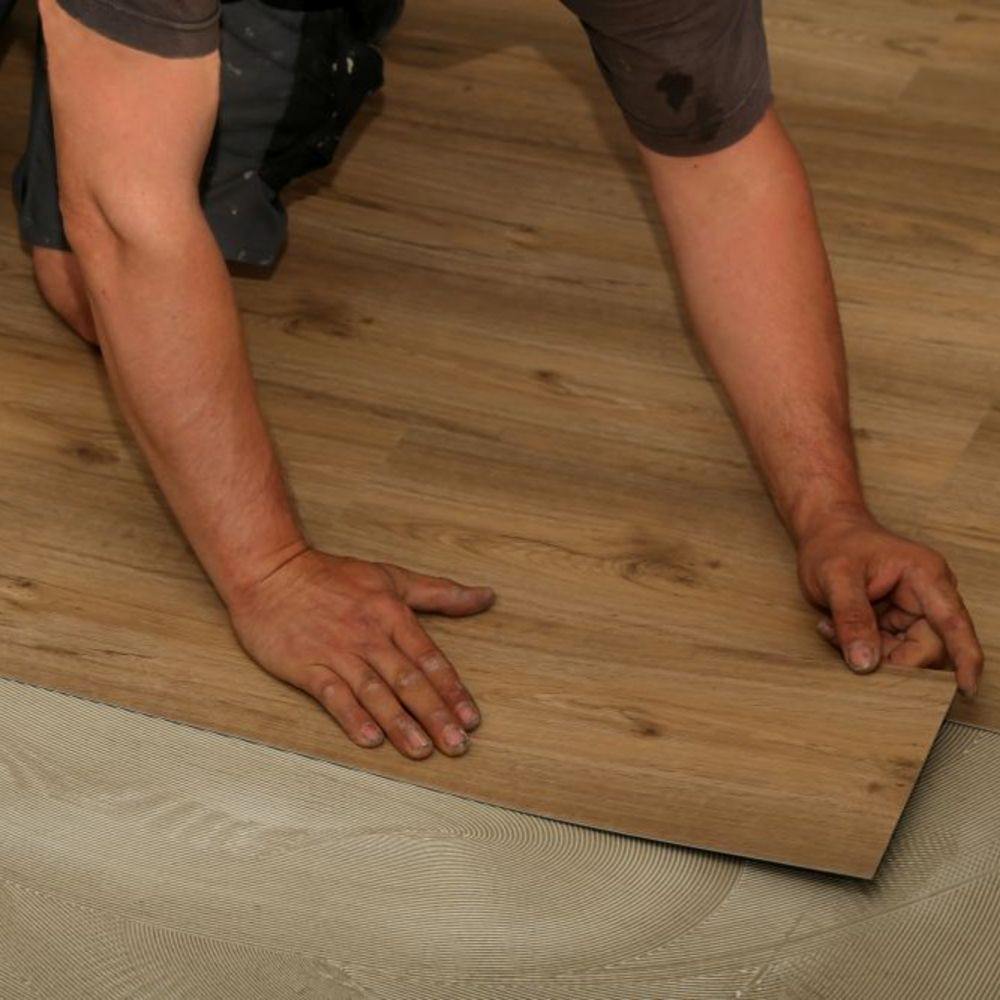

When installing glue-down luxury vinyl tile (LVT), proper subfloor preparation is essential for a smooth, stable, and long-lasting result. One common question is whether the entire subfloor needs to be skim coated before installation.
The short answer is no. A full skim coat is not required for every LVT installation.
Whether skim coating is necessary depends on the type and condition of the existing substrate. The goal is to create a surface that is clean, dry, smooth, structurally sound, and properly prepared to receive resilient flooring.
What Is a Skim Coat?
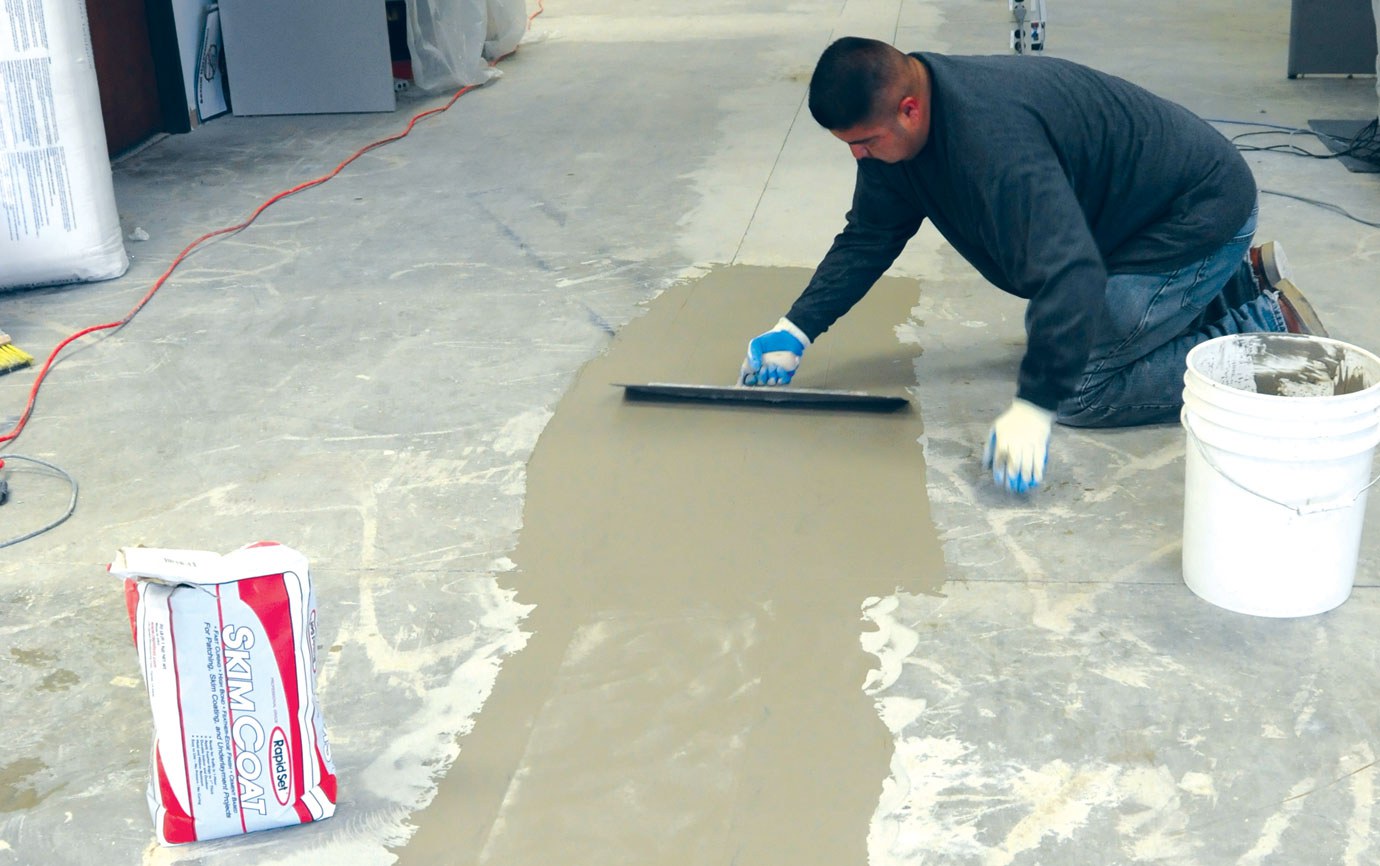
A skim coat is a thin layer of floor-preparation material applied over a substrate to smooth minor surface imperfections, fill texture or grout lines, and create a more uniform surface before flooring is installed.
For glue-down LVT, this can be especially important because imperfections in the substrate may become visible through the finished flooring, a condition commonly known as telegraphing.
However, skim coating should be used where the condition of the substrate requires it, rather than automatically applied to every installation.
When Is a Full Skim Coat Not Necessary?
A full skim coat may not be necessary when the existing substrate is already:
- Clean and free of contaminants
- Dry and within the requirements of the flooring and adhesive manufacturers
- Smooth and properly prepared
- Structurally sound and stable
- Free from significant holes, grooves, depressions, or other surface defects
For concrete substrates, preparation should follow ASTM F710 along with the written requirements of the flooring, adhesive, and floor-preparation manufacturers.
For panel-type underlayments, preparation should follow ASTM F1482 together with the applicable manufacturer's instructions.
When May Skim Coating or Additional Preparation Be Needed?
Different substrates can require different preparation methods.
Concrete with Holes, Grooves, or Depressions
Surface cracks, grooves, depressions, control joints, and other non-moving joints should be properly treated with a compatible patching or underlayment compound.
Depending on the condition of the concrete, localized patching and feather finishing may be sufficient instead of skim coating the entire floor.
Rough or Uneven Concrete
Rough or uneven concrete may require more extensive preparation, such as:
- Mechanical grinding
- Cementitious patching
- Self-leveling underlayment
The appropriate method depends on the severity and type of surface irregularity.
A thin skim coat should not be considered a solution for major differences in elevation or significant high spots.
Ceramic Tile or Terrazzo
When installing LVT over suitable existing ceramic tile or terrazzo, grout lines and surface texture may telegraph through the finished floor.
In these situations, an appropriate primer and light skim coat or embossing leveler is often needed to create a sufficiently smooth surface.
Existing Embossed Resilient Flooring
Existing resilient flooring with a noticeable embossed pattern may also require additional preparation.
A compatible embossing leveler or approved porous underlayment may be used where permitted by the applicable flooring and preparation-product manufacturers.
Panel-Type Underlayments
For wood-based panels, fiber-reinforced gypsum panels, or fiber-cement panels, joints, fastener heads, thickness differences, and surface imperfections must be properly addressed.
Patching or skim coating may be required depending on the instructions provided by the panel and flooring manufacturers.
The finished surface should be smooth enough that joints, texture, and other imperfections do not telegraph through the LVT.
Concrete Subfloors Require More Than a Smooth Surface
A concrete floor may look smooth and still not be ready for glue-down LVT.
Under ASTM F710, concrete substrates should be evaluated and prepared before resilient flooring is installed. Among the important considerations are:
- The concrete should be clean, dry, smooth, sound, and stable.
- Dust, grease, paint, wax, sealers, curing compounds, old adhesive, and other materials that could interfere with adhesion should be removed.
- Concrete slabs should be tested for moisture, regardless of the age of the slab or whether it is on-grade, above-grade, or below-grade.
- Concrete should also be tested for pH before resilient flooring is installed.
- On-grade and below-grade slabs require an effective, permanent moisture-vapor retarder beneath the slab.
- Where adhesion is in question, appropriate bond testing and surface preparation may be necessary.
Importantly, ASTM F710 does not establish one universal acceptable moisture or pH limit for every LVT installation. Acceptable limits should be determined from the current technical requirements of the specific flooring and adhesive manufacturers.
What a Skim Coat Cannot Fix
A skim coat is primarily a surface-preparation solution. It should not be used as a substitute for correcting more serious substrate problems.
A thin skim coat alone cannot correct:
- Structural movement
- Hydrostatic pressure
- Moisture levels exceeding the allowable limits
- Significant high spots
- Major elevation differences
- An unstable or deflecting subfloor
These conditions may require different corrective measures before the LVT installation can proceed.
What Do ASTM F710 and ASTM F1482 Require?
Neither ASTM F710 nor ASTM F1482 requires a full skim coat for every glue-down LVT installation.
Instead, the substrate should be evaluated and prepared appropriately for resilient flooring.
ASTM F710 applies to the preparation of concrete floors, while ASTM F1482 covers the installation and preparation of panel-type underlayments used beneath resilient flooring.
In both cases, ASTM standards should be considered together with the current written instructions from the flooring, adhesive, underlayment, and floor-preparation manufacturers.
The Bottom Line
You do not automatically need to skim coat the entire floor before installing glue-down LVT.
What matters is the condition of the substrate.
A clean, dry, smooth, structurally sound, and properly prepared substrate may not require a full skim coat. However, holes, depressions, grout lines, embossed surfaces, panel joints, rough concrete, or other imperfections may require patching, skim coating, grinding, leveling, or another appropriate preparation method.
The substrate should be prepared in accordance with ASTM F710 for concrete or ASTM F1482 for panel-type underlayments, together with the written requirements of the flooring, floor-preparation, and adhesive manufacturers.
Skim coating or patching should be performed where necessary to achieve a suitable surface for LVT installation.